Rediscovering My Early Tech Predictions
I’ve always considered myself a tech evangelist and a futurist. For me, that means two things: I stay immersed in technology across the board, and I genuinely enjoy imagining where it’s all heading and how it will shape our lives. Back in my younger days, when free time was bountiful (and you could use em dashes without scrutiny), I often spent it putting pen to paper and writing about whatever technology captured my imagination.
I was reminded of that recently when I discovered a post I wrote many years ago. In it, I celebrated the magic of the first iPhone, streaming audio, car infotainment, accessible home automation, and gorgeous HD televisions. I wrote about the dawn of a tech renaissance that my 10-year-old self could only have dreamed about, and where I thought it might take us. My prediction back then was simple: life was amazing, and only going to get better.
The Acceleration of the Last 12 Months
Fast forward to today, and that same sense of wonder is back, only amplified. The last 12 months alone have moved faster than anything I’ve seen in my lifetime. Even for someone who sits at the far left of the adoption curve, it is a lot to process. And if it’s not obvious, I’m talking about AI.
What makes it dizzying isn’t fear of runaway systems or mass job replacement. It’s the scale of what there is to learn, evaluate, and piece together. Understanding which tools matter, where they apply, and how to use them well is a full-time pursuit.
The Next Stage: AI That Actually Does Things
The moment these tools became real, I immediately began to ponder the next stage.
The assistant that can take a calendar invite from my wife, asking to “make reservations on December 13th at 6pm near Wellesley,” and handle it end-to-end. No searching OpenTable. No comparing reviews. Just done. This will be a reality soon, and not just for the bleeding-edge minority using n8n or Zapier to stitch their world together today.
I want a health assistant that has access to every single one of my medical records from the day I was born. I want it to connect to my Apple Watch and capture real-time biometrics. I want a log of everything I eat. How much I drink. And when you think about input devices, it becomes obvious why the major tech players are pushing so hard into augmented reality eyewear. Why is this important to me? Well, biohacking is pretty cool, and in my personal experience with what is considered the best healthcare in the world, I am starting to trust my “Health GPT” more than the specialist who doesn’t appear to be all that interested in your well-being. If you have spent time training a GPT for health and fitness, you know what I’m talking about. Healthcare is about to be revolutionized.
Why am I still manually adding items to my Whole Foods shopping cart? Meal planning? What a waste of time! I want my “What’s for Dinner” GPT, loaded with every recipe I’ve made for all of time, and knowledge of every item I’ve purchased from Whole Foods over the last decade, to be connected to my fridge (come on Sub-Zero, let’s make it happen) and connected to my Amazon account. We can have a discussion with Alexa on Sunday about what meals will be made for the week, citing my family members’ personal tastes, the time of year, and current store sales. After it analyzes my calendar, it will generate a meal plan, I will sign off (or maybe I won’t), and the grocery order will be placed. I’m certain the team at Amazon is working on this as I type.
When I think about other areas where agentic AI will have a massive impact at home, wrangling a family of five stands out. There’s so much invisible overhead: the medical forms every sport seems to require, the weekly family planner that is constantly in a state of flux, the rotating carpool arrangements, the permission slips, the scheduling collisions…the list is endless. If you’re a parent, you know all too well that even with the best nanny in the world (which we are lucky enough to have), it’s a lot to handle. I want a household COO. My wife holds that title today, and I know she would be thrilled to hand a chunk of that mental load to a capable copilot.
What Makes These Workflows Possible – and What Holds Them Back
These “simple” requests rest on a foundation that’s actually pretty straightforward:
- You need the data. Everything from your historical patterns to real-time signals.
- You need the connections. Secure, bi-directional access between the apps, services, and devices that support your life.
- And you need to trust the system. Handing over decision-making only works if you believe the agent will act exactly as you would, or better.
The first two are operational. They are engineering problems, and we are rapidly solving them. The third is the real hurdle. It’s where people hesitate. It’s where companies slow down deals. Giving an agent true autonomy requires confidence, earned confidence, that it will behave the way you want it to.
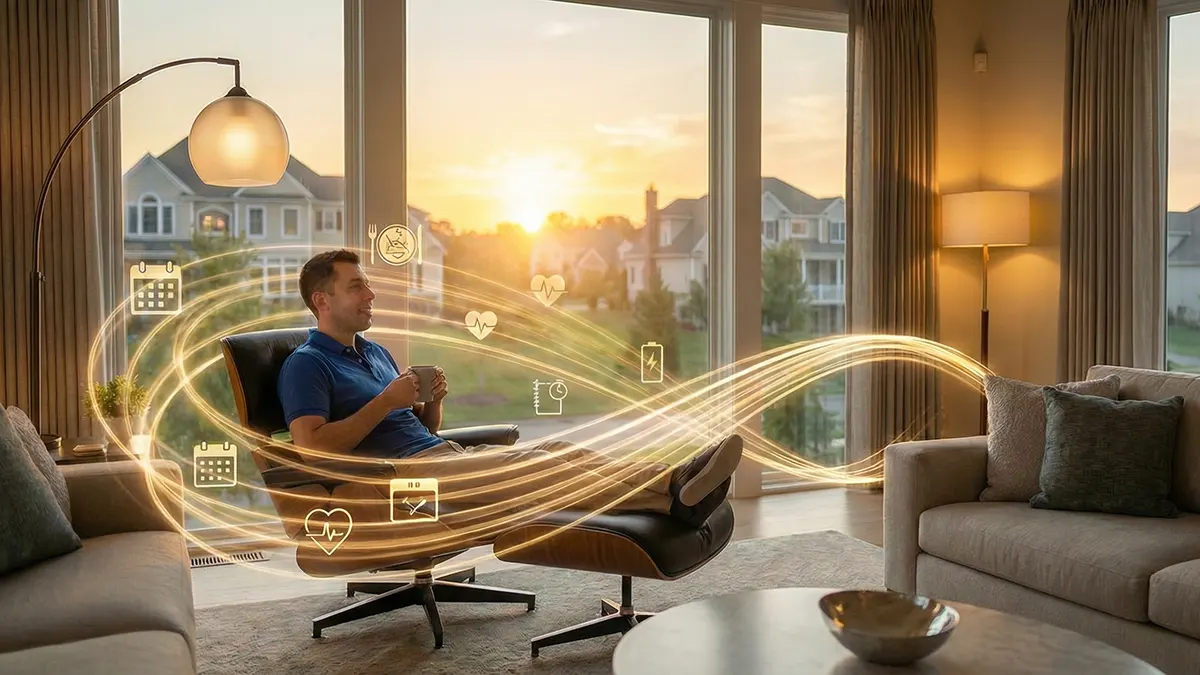
The Shift from “Human-in-the-Loop” to “Human kicking back and sipping a cocktail”
Right now, most AI workflows keep us involved. Review this. Approve that. Confirm before sending. A human is “in the loop.” That level of oversight makes sense for where we are, but it is only a stepping stone. To unlock the full promise of these systems, human involvement will need to shrink substantially. That transition will not be immediate, but momentum is building faster than most realize.
Yes, I may be oversimplifying a bit. The systems today are very fragmented. Raise your hand if you use Alexa, Google Home, and Siri concurrently in your kitchen. Mine is up. But things will shake out, swim lanes will be established, and the integration points will come online.
A Future No One Predicted
I’ve never been more excited for the advancements in consumer and business tech that are upon us. The next few years are going to be wild. Yes, there will be a lot of disruption. A lot of questions demanding answers. A lot of FUD will be thrown against the wall as these systems mature. But with the right stewardship, this shift has the potential to change the world, for the better.
The eternal optimist that I am fully believes we’re on the cusp of a future no one could have imagined back when I was waxing poetic about the first iPhone. I cannot wait to see what comes next.
Leave a Reply